Free resource: FIFO Psychosocial Risk Control Plan Guide + Template
For WHS, People & Culture, operations and remote workforce leaders
Psychosocial capability built for FIFO & remote workforces.
FIFO Mind Connect is more than a once-off induction. Start with FIFO-specific psychosocial awareness, then build an ongoing capability layer around the systems you already have.

- FIFO-specific induction and leader capability as the foundation
- 52 toolbox and prestart topics plus the digital Support Hub
- Designed to fit alongside WHS, HSE, EAP and existing site systems
Additional support pathways and specialist initiatives can be explored where workforce needs call for them.
01
Start with a strong foundation
FIFO-specific psychosocial awareness and leader capability designed for real remote-work conditions.
02
Reinforce it throughout the year
Toolbox conversations, practical resources and the Support Hub help keep capability active after induction.
03
Scale around workforce need
Implementation support and additional pathways can be scoped without forcing organisations into a fixed package.
The gap FMC is designed to address
The challenge is not always a lack of support. It is connecting the pieces.
Remote operations may already have policies, EAP, safety systems, site leadership and wellbeing activity. Those systems work better when workers and leaders can recognise what is changing early, understand their role and know what happens next.
Recognition
Early warning signs and work-related psychosocial hazards need a shared language across crews and leaders.
Response
People need practical boundaries and clear pathways so concern can become appropriate action rather than uncertainty.
Reinforcement
Capability fades if the conversation stops when an induction is completed. Ongoing prompts and resources matter.
Connection
Existing EAP, WHS, HSE, medical and professional supports are more useful when people know how and when to reach them.
The FMC framework
One system. Multiple layers.
The induction is the foundation, not the whole story. FIFO Mind Connect is designed to help organisations build capability over time — from awareness and early recognition through to practical response, support connections and review.
PREVENT
Build capability early
FIFO-specific awareness and education that helps workers and leaders understand psychosocial hazards before they escalate.
RECOGNISE
Notice what is changing
Build a shared language around early warning signs, work-related risk factors and when something needs attention.
RESPOND
Make the next step clearer
Practical conversations, role boundaries and referral pathways that fit the organisation’s existing systems.
SUPPORT
Connect people to the right help
Strengthen access to appropriate internal, professional or specialist support when the situation calls for it.
REVIEW
Keep improving
Use participation, feedback and implementation evidence to review what is working and what needs attention next.
The foundation
FIFO Mind Connect psychosocial risk awareness induction.
The induction creates the shared language and early-response capability the broader FMC ecosystem builds from. It is designed for FIFO and remote workforces and can sit inside the organisation’s existing learning environment.
FMC supports a broader psychosocial risk-management framework. It is not represented as the employer’s sole control, a substitute for statutory WHS duties, or a replacement for clinical support.
FIFO-specific psychosocial awareness
Practical learning built around remote-work realities rather than generic office examples.
Frontline and leader pathways
Role-relevant capability for workers and leaders, with clear boundaries around response and escalation.
Notice. Ask. Listen. Link.
A simple conversation and referral framework that gives people a practical next step without turning peers into counsellors.
Aligned support pathways
Support and escalation information can be aligned to the organisation’s own systems and available services.
Client LMS / induction delivery
Designed for deployment through existing learning infrastructure where required, including SCORM-based delivery.
Ongoing review
The core content can be reviewed and refreshed as guidance, workforce needs and implementation priorities evolve.
Implementation
Built around the systems you already have.
FMC is designed to sit alongside existing WHS, HSE, EAP, medical, induction and site leadership processes — not create another disconnected system for teams to manage.
Scope
Confirm workforce numbers, locations, existing systems and the outcome the organisation is trying to achieve.
Configure
Select the right capability layers, align pathways and tailor support information to the site.
Deploy
Launch the core induction and leader pathway through the agreed learning environment.
Reinforce
Use toolbox content, the Support Hub and practical communication to keep the capability active.
Review
Look at participation, feedback and implementation evidence to identify what should happen next.
Beyond the core program
When the workforce needs more.
Not every site needs the same response. Where needs extend beyond the core FMC capability, The Brave Mind Project can work with organisations to explore additional support pathways, facilitated programs and specialist partnerships. These are scoped to the organisation and workforce rather than offered as a fixed catalogue.
Professional support pathways
Where the workforce needs more than education and awareness, appropriate professional support options can be explored as part of the broader response pathway.
Facilitated workforce programs
Targeted programs may be scoped around identified workforce needs such as relationships, transition, communication, stress, family connection or leadership capability.
Approved specialist partners
Specialist organisations can be incorporated where they add genuine value and the delivery scope, qualifications, responsibilities and commercial terms are clear.
Designed to Support Organisational Alignment
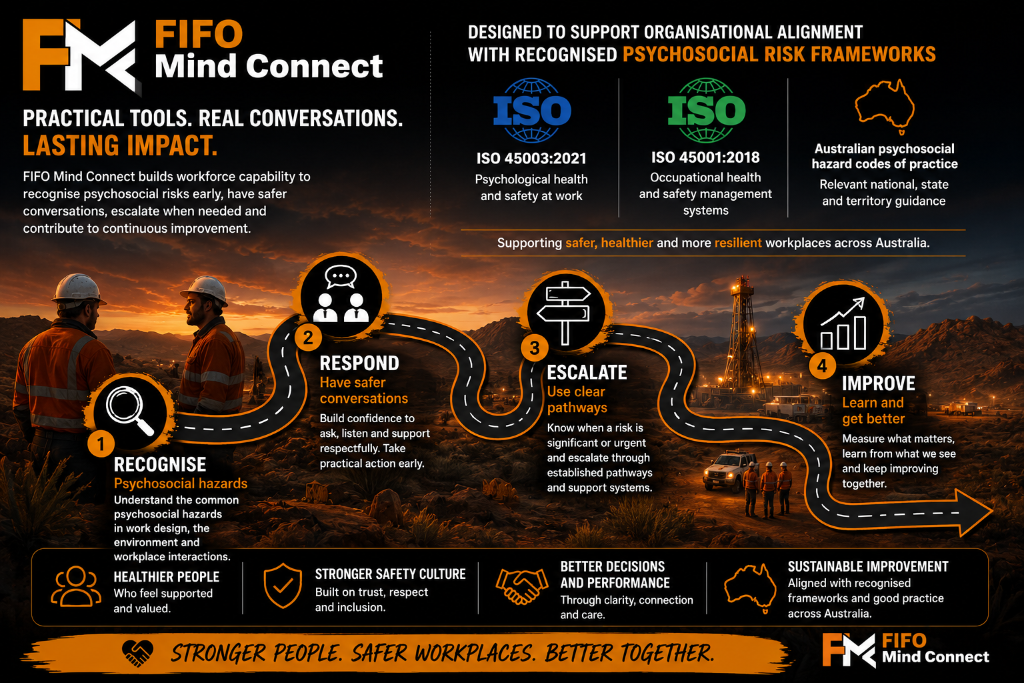
FIFO Mind Connect is designed to support organisational alignment with recognised psychosocial risk frameworks, including ISO 45003:2021, ISO 45001:2018 and relevant Australian psychosocial hazard codes of practice and guidance.
FIFO Mind Connect helps organisations strengthen psychosocial risk awareness across FIFO and remote-work environments. The program supports earlier recognition of workplace risks, safer conversations, clear escalation pathways and ongoing improvement.
Questions organisations ask